Why Keyboards Are QWERTY: The Jam Myth vs. the Telegraph Record
The first typewriter sold, in 1868, had 28 keys in A-to-Z order. QWERTY came later, shaped by telegraph users, its inventor and a fight over patents.
Prefer reading? The write-up below tells the same story with the same sources. Open on YouTube.
The numbers
Type-bar gap for ER, the 2nd most common letter pair
16°
Look at the top row of your keyboard and the letters make no obvious sense: Q, W, E, R, T, Y. Yet the first typewriter shipped to a customer, in November 1868, had its 28 keys in alphabetical order, according to a 2011 Kyoto University study of the machine’s early history. Somewhere between that machine and yours, the alphabet was scrambled, and the usual explanation for why does not match the record.
The answer everyone has heard, and why it sounds right
Ask why the letters sit where they do and most people give the same answer. Early typewriters jammed, so the letters were scrambled to slow typists down. A 1982 ACM SIGSOC Bulletin article said almost exactly that: the layout “was intended to slow down the operator so that type bars would not jam.”
A milder version is still in circulation. When the American Society of Mechanical Engineers named the Sholes & Glidden Type-Writer a historic landmark in 2011, its plaque said the layout “minimized sticking keys.” That is not quite the slowing story, but it rests on the same idea: the order was chosen to protect the machine.
The mechanics give the story real support. In Christopher Latham Sholes’s 1878 patent, US Patent 207,559, the types are arranged so they “all strike up against the same point” at the bottom of the platen. Every type bar swings to one shared spot. Picture two bars rising at once, and a collision is easy to imagine.
That patent also contains a keyboard drawing worth keeping in mind. Its top letter row reads Q-W-E-R-T-Y-U-I-O-P, exactly like yours. Its bottom letter row does not: it runs Z, C, X, V, B, N, and M sits at the end of the middle row instead. That small difference turns out to matter.
Testing the jam theory against the type bars
If the layout was built to keep busy letter pairs apart, the machine’s ring of type bars should show it. Pairs typed often would sit far apart on the ring, so their bars would rarely rise from neighbouring slots. The Kyoto study, by Yasuoka and Yasuoka, lists the angle between the bars for the 30 most common English letter pairs on the Sholes & Glidden, with pair frequencies taken from a 1949 count by Griffith.
The most common pair, TH counted together with HT, does sit on opposite sides of the ring, 180 degrees apart. But ER, the very next pair, sits just 16 degrees apart. Those are neighbouring bars. Here are the top ten, from the study’s Table 1:
| Rank | Letter pair | Degrees apart | Under a quarter turn? |
|---|---|---|---|
| 1 | TH + HT | 180 | no |
| 2 | ER + RE | 16 | yes |
| 3 | HE + EH | 147 | no |
| 4 | IN + NI | 123 | no |
| 5 | AN + NA | 106 | no |
| 6 | IT + TI | 49 | yes |
| 7 | AT + TA | 82 | yes |
| 8 | EN + NE | 155 | no |
| 9 | ET + TE | 33 | yes |
| 10 | ON + NO | 106 | no |
Four of the top ten pairs (ER, IT, AT and ET) sit less than 90 degrees apart. Across all 30 pairs in the table, 13 do. A layout designed to separate busy pairs would hardly leave the second busiest pair on adjacent bars. So what was the order built around?
Follow the customers to the telegraph room
The study’s answer starts with who bought the machine. The first customer, in November 1868, was Edward Payson Porter, principal of Porter’s Telegraph College in Chicago. By April 1870, a new version had 38 keys, now including numerals, because telegraph operators taking down messages needed them, according to Yasuoka and Yasuoka. When the machine appeared on the front page of Scientific American in August 1872, it had 42 keys.
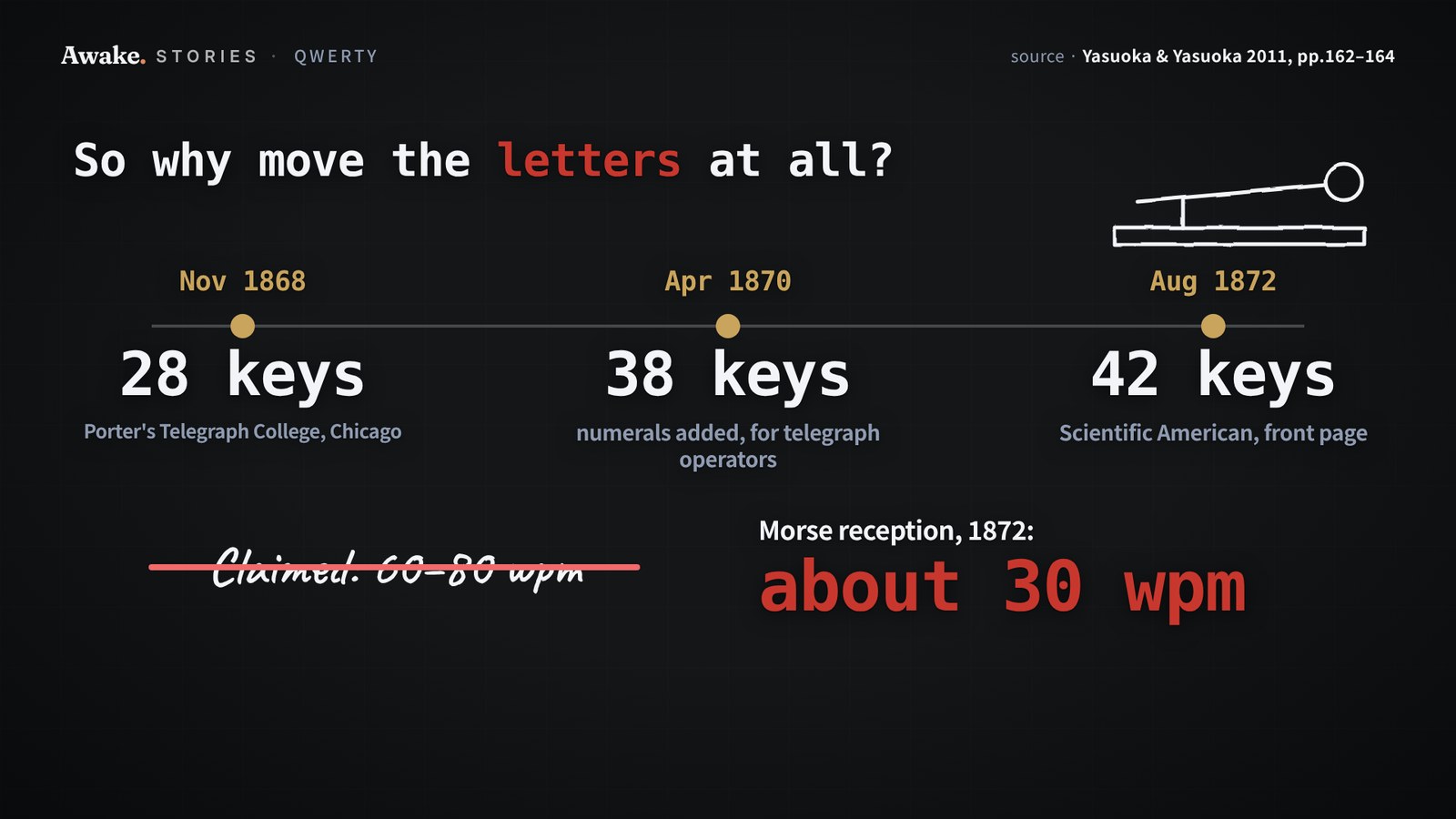
That 1872 article claimed anyone could learn to write 60 to 80 words a minute. The study calls this an overstatement: operators receiving Morse code reached about 30 words a minute. The detail that matters is who these users were. They were transcribing a sender in real time, and a keyboard built to slow them down would have worked against the very people buying it.
Z, S and E: a Morse clue on your keyboard
Then two telegraph businessmen, Harrington and Craig, asked for changes. Compared with the 1870 layout as the study reconstructs it, only 13 letters were still in the same place by 1872. The rest had moved.
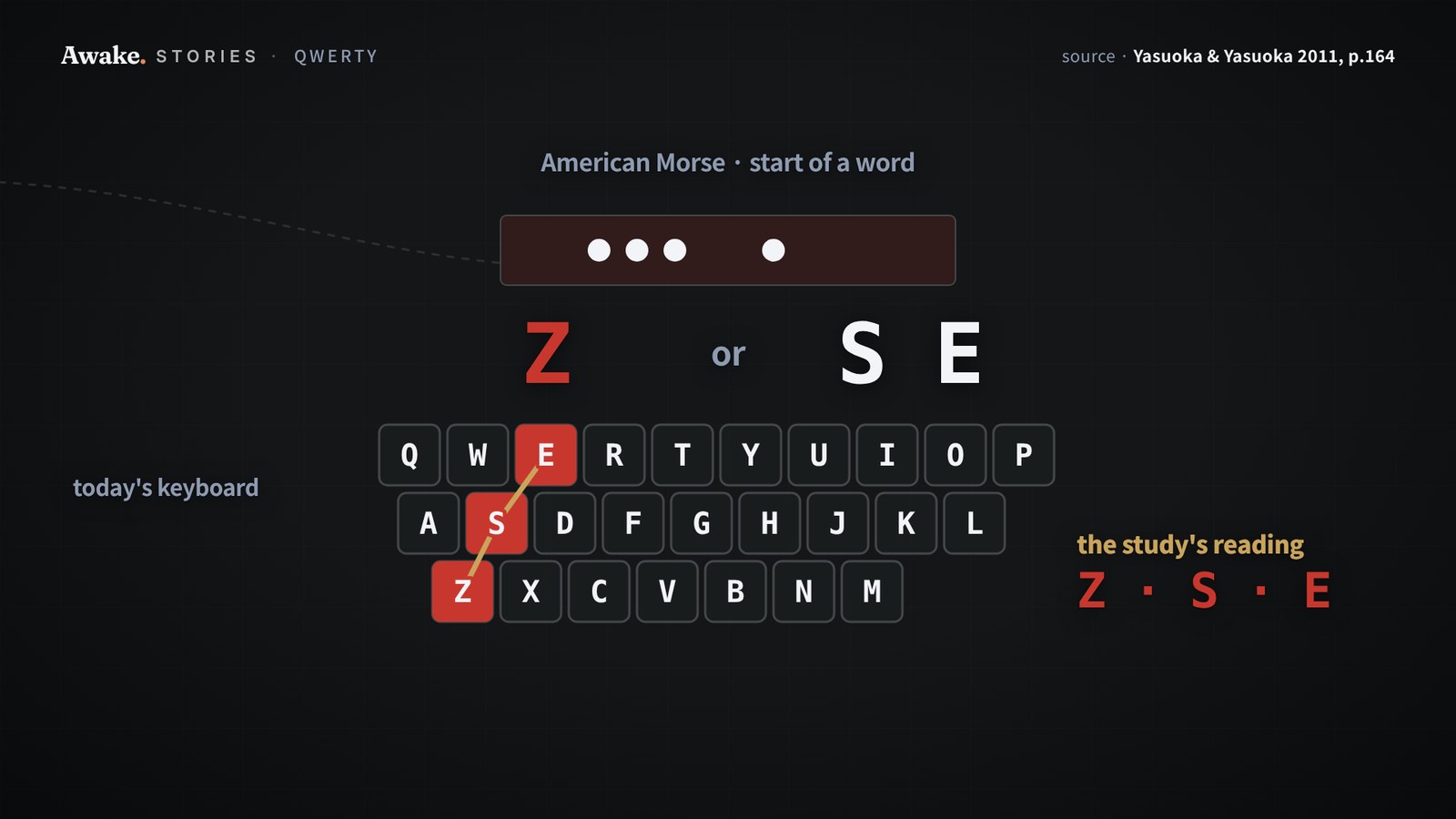
The study points to one reason. In American Morse code, Z is easily confused with the pair S-E, so at the start of a word a receiver often could not tell which was meant. Yasuoka and Yasuoka argue that this is why S was placed between Z and E, keeping the confusable letters together. Look down at your own keyboard: Z, S and E still sit in a slanting line.
The inventor’s last demand
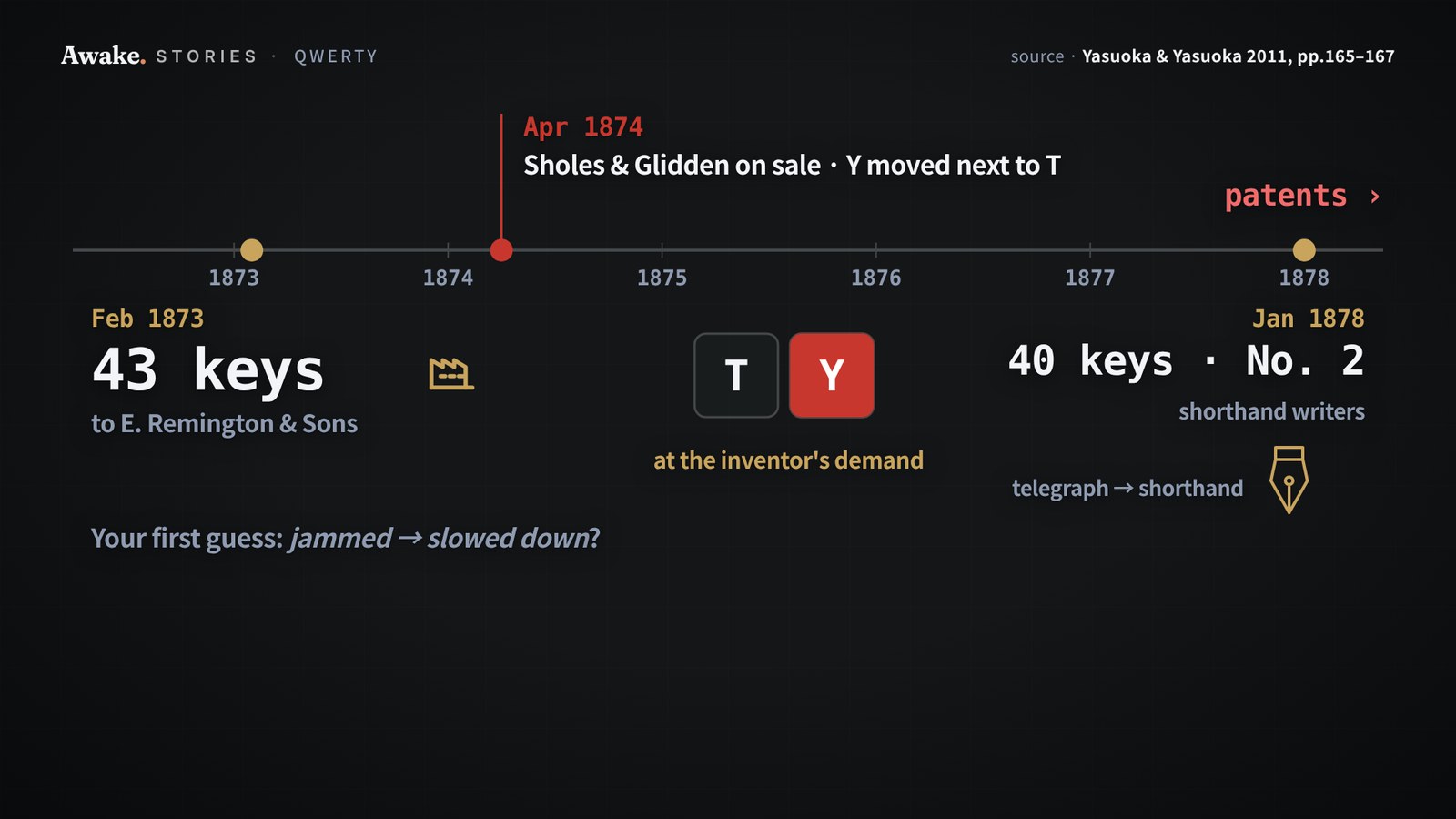
In February 1873, the machine, now with 43 keys, went to the manufacturer E. Remington & Sons in Ilion, New York. Before the Sholes & Glidden Type-Writer went on sale in April 1874, Sholes demanded one more change: Y moved to the middle of the row, next to T. The study treats this stage as a compromise between the inventors and the makers.
By January 1878, the Remington Type-Writer No. 2 had 40 keys, with a shift so the same key could print a capital or a small letter. Its customers had changed too, the study notes: no longer telegraphers, but mostly shorthand writers. The video walks through this stretch on a zoomed-in timeline, and it ends on a clue. The last move had nothing to do with typing at all.
A patent fight, and why the order stuck
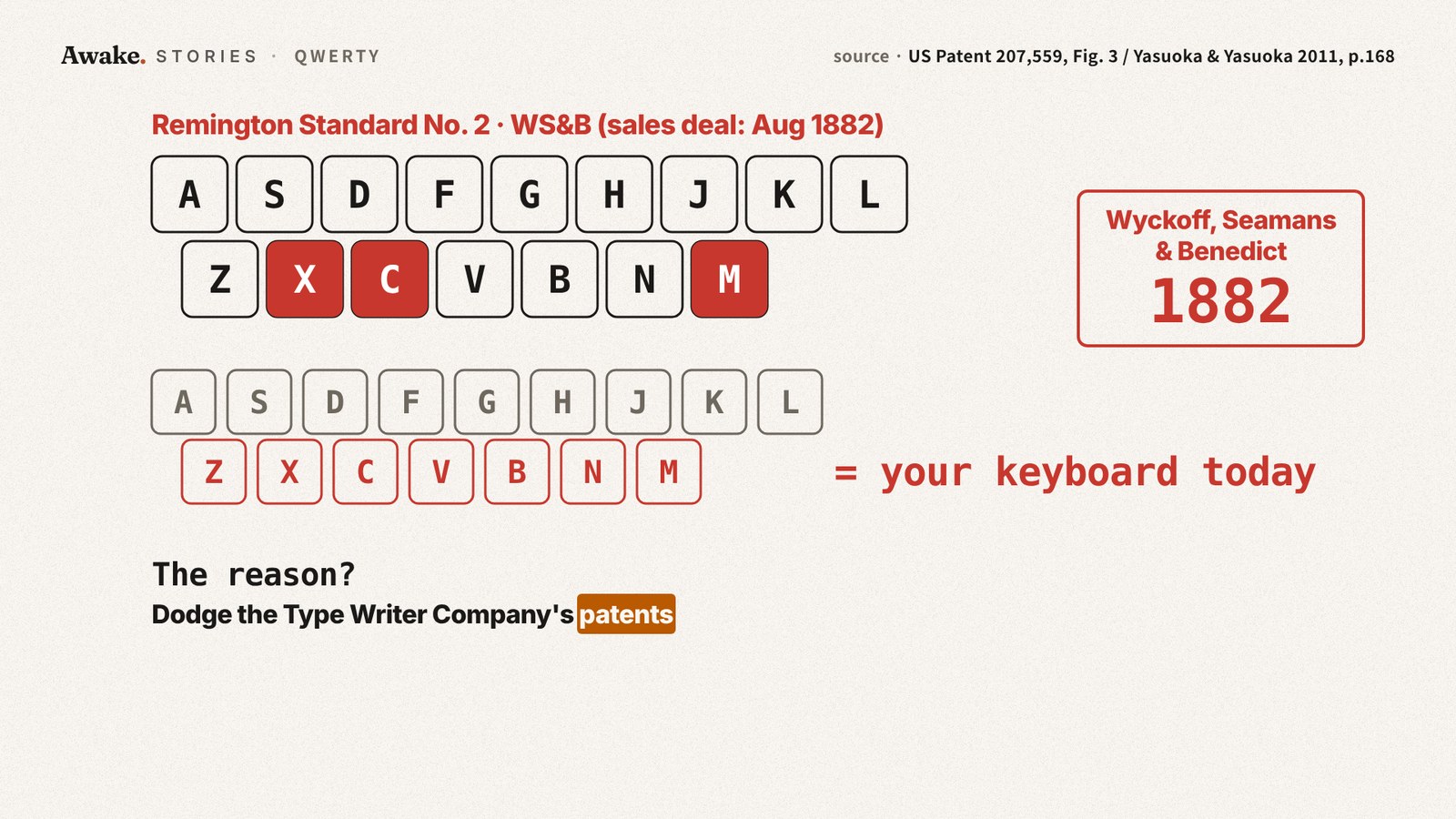
Go back to the 1878 patent drawing, with M at the end of the middle row and C and X swapped in the bottom row. The exact order you use came from a new sales company, Wyckoff, Seamans & Benedict, set up in August 1882 to sell the machine. On its Remington Standard Type-Writer No. 2, M moved next to N, and C and X traded places.
The reason, according to Yasuoka and Yasuoka, was to get around patents held by the Type Writer Company. After that change, the bottom row read Z-X-C-V-B-N-M, the row under your fingers today.
The study’s conclusion is blunt. It calls the slow-down story false, because the first customers were Morse receivers who had to keep pace with the sender. Its verdict: “There was no consistent policy towards QWERTY.” The layout changed first to receive telegraphs, then as a compromise between inventors and makers, then to dodge patents. Counting from Sholes’s first typewriter patent, granted in June 1868, that took more than a decade.
If the order was a series of patches, why did it last? Because it spread. In 1893, five leading makers (Remington, Caligraph, Yost, Densmore and Smith-Premier) joined one trust, the Union Typewriter Company. As they put QWERTY on their machines, it became the de facto standard by June 1898, the study says.
From there the path runs straight to your desk. Teletype adopted QWERTY in the 1910s, and Teletype machines were widely used as computer terminals from the 1940s to the 1970s. Computer keyboards inherited the layout from them.
What changes once you see it
The strange order is not a puzzle someone solved in one go. It is a record of who pushed on it, and when. Z, S and E from the telegraph room, by the study’s reading. Y beside T from the inventor. M beside N, and C swapped with X, from a patent fight.
The jam story survives because the mechanism makes it plausible. The type-bar angles and the dated changes point somewhere else.
Sources
- Yasuoka & Yasuoka, 'On the Prehistory of QWERTY', ZINBUN 42 (2011) pp.161-174, p.162 — Institute for Research in Humanities, Kyoto University (ZINBUN No.42, peer-reviewed) (2011) · https://repository.kulib.kyoto-u.ac.jp/dspace/bitstream/2433/139379/1/42_161.pdf
- US Patent 79,265, 'Improvement in type-writing machines' (C. L. Sholes, C. Glidden, S. W. Soule), granted 1868-06-23 — United States Patent Office (via Google Patents full text) (1868) · https://patents.google.com/patent/US79265A/en
- US Patent 207,559, 'Improvement in Type-Writing Machines' (C. Latham Sholes), granted 1878-08-27; keyboard in drawing sheet 2, Fig. 3 — United States Patent Office (via Google Patents full text and drawings) (1878) · https://patents.google.com/patent/US207559A/en
- Early Office Museum: Office Typewriters (Sholes & Glidden ~ Remington No. 1) — Early Office Museum (officemuseum.com) (1874) · https://www.officemuseum.com/typewriters_office_models.htm
- ASME, 'Sholes & Glidden Type Writer: A Historic Mechanical Engineering Landmark' (2011), Text of Landmark Plaque, p.8 — American Society of Mechanical Engineers (ASME), Landmark No. 249 brochure (2011) · https://www.asme.org/wwwasmeorg/media/ResourceFiles/AboutASME/Who%20We%20Are/Engineering%20History/Landmarks/249-Sholes-Glidden-Type-Writer.pdf
Photos: Video: KoolShooters / Pexels (https://www.pexels.com/video/close-up-shot-of-a-person-using-typewriter-6979935/) · Photo: MART PRODUCTION / Pexels (https://www.pexels.com/photo/photo-of-documents-beside-a-typewriter-8872430/) · Photo: Arturo A / Pexels (https://www.pexels.com/photo/metal-typefaces-of-typewriter-14018466/) · Photo: DΛVΞ GΛRCIΛ / Pexels (https://www.pexels.com/photo/vintage-black-and-white-typewriter-close-up-32836042/) · Photo: cottonbro studio / Pexels (https://www.pexels.com/photo/close-up-of-a-typewriter-5137961/)
 Up next · EverydayAre Video Games More Expensive Than Ever? GTA VI's $80 in Real Dollars


