First Billionaire: Did Rockefeller Ever Actually Reach $1 Billion?
Rockefeller was crowned the first billionaire in 1916, yet biographer Ron Chernow puts his peak at $900 million in 1913, $100 million short of the headline.
Prefer reading? The write-up below tells the same story with the same sources. Open on YouTube.
The numbers
Rockefeller's peak net worth, 1913 · Chernow estimate
$900M
Ask who the first person to own a billion dollars was, and most people already have a name ready. That name got its crown on 29 September 1916, when newspapers across America ran the same story, as Money’s 2016 account of the episode describes. The more useful question is who did the counting, and what exactly they counted.
The case for Rockefeller
The obvious answer is John D. Rockefeller. A Guinness World Records entry titled “First dollar billionaire”, with a record date of 2010 and now visible in archived copies, named him outright. The business side of the case looks just as strong. By the count of Global Financial Data (now Finaeon), Standard Oil, with all of its subsidiaries included, became the first company worth over $1 billion: $1.1 billion in August 1912.
His stake in that empire was large. When the Supreme Court ordered the New Jersey company broken up in 1911, he owned 244,500 of its 983,383 shares, according to the Rockefeller Archive Center. That is about 24.9%, or roughly a quarter of the company. Keep the Guinness entry in mind, though, because the same record book has a second page about him, and it says something different.
Redoing the 1916 arithmetic
The 1916 figure is easier to judge once you rebuild it. As Money’s 2016 summary of the newspaper reports explains, the papers started with his stock: 247,692 Standard Oil shares. Standard Oil of New Jersey’s share price had risen the day before, and the papers put those shares at close to $499 million. That is about 49.9% of the billion, roughly half.
The other half came from everything else. The account added his other holdings in banks, railroads, and government and city bonds until the total reached $1 billion. The summary gives no separate amounts for those holdings. What the headlines announced was a newspaper estimate, not an audited figure. It also means that half of the famous billion rested on a share price, which raises the next question: how steady was that price?
A fortune that moves with a share price
No 1916 share price turned up in the records behind the video. What can be charted is the older Standard Oil stock that carried every subsidiary. That is a different security from the one the papers priced, but it shows how much the company’s value moved. On Global Financial Data’s records, the shares hit $842 in May 1901. When they stopped trading in August 1912, they stood at $1,100.
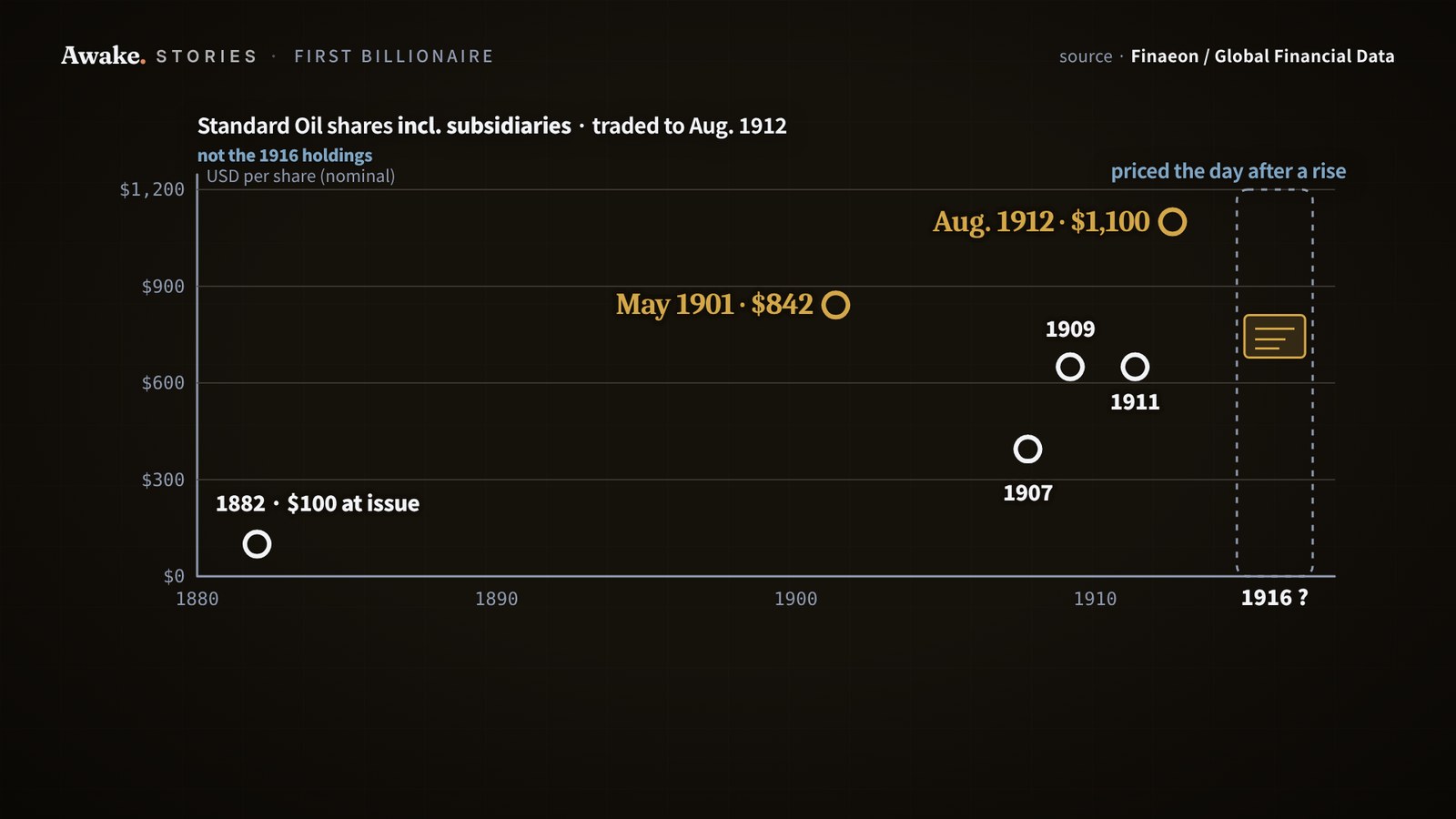
Between those two dates, the Finaeon article gives only a handful of prices:
| Date | Price per share (nominal USD) | Note |
|---|---|---|
| 1882 | $100 | at issue |
| May 1901 | $842 | peak before the panic |
| 1907 | $395 | Panic of 1907 |
| March 1909 | $650 | recovered |
| 1911 | $650 | court-ordered dissolution |
| August 1912 | $1,100 | last trade, incl. subsidiaries |
The chart shows these as separate markers because the source gives nothing in between. Even so, the pattern is clear. A fortune counted in shares rises and falls with them, so a value taken the day after a jump includes the jump.
A doubt from inside the family
One doubt about the billion came from within the family. His son, John D. Rockefeller Jr., issued a statement calling the billionaire report an exaggeration, according to Money’s 2016 account. Some of the reason lies in what was already happening to the money.
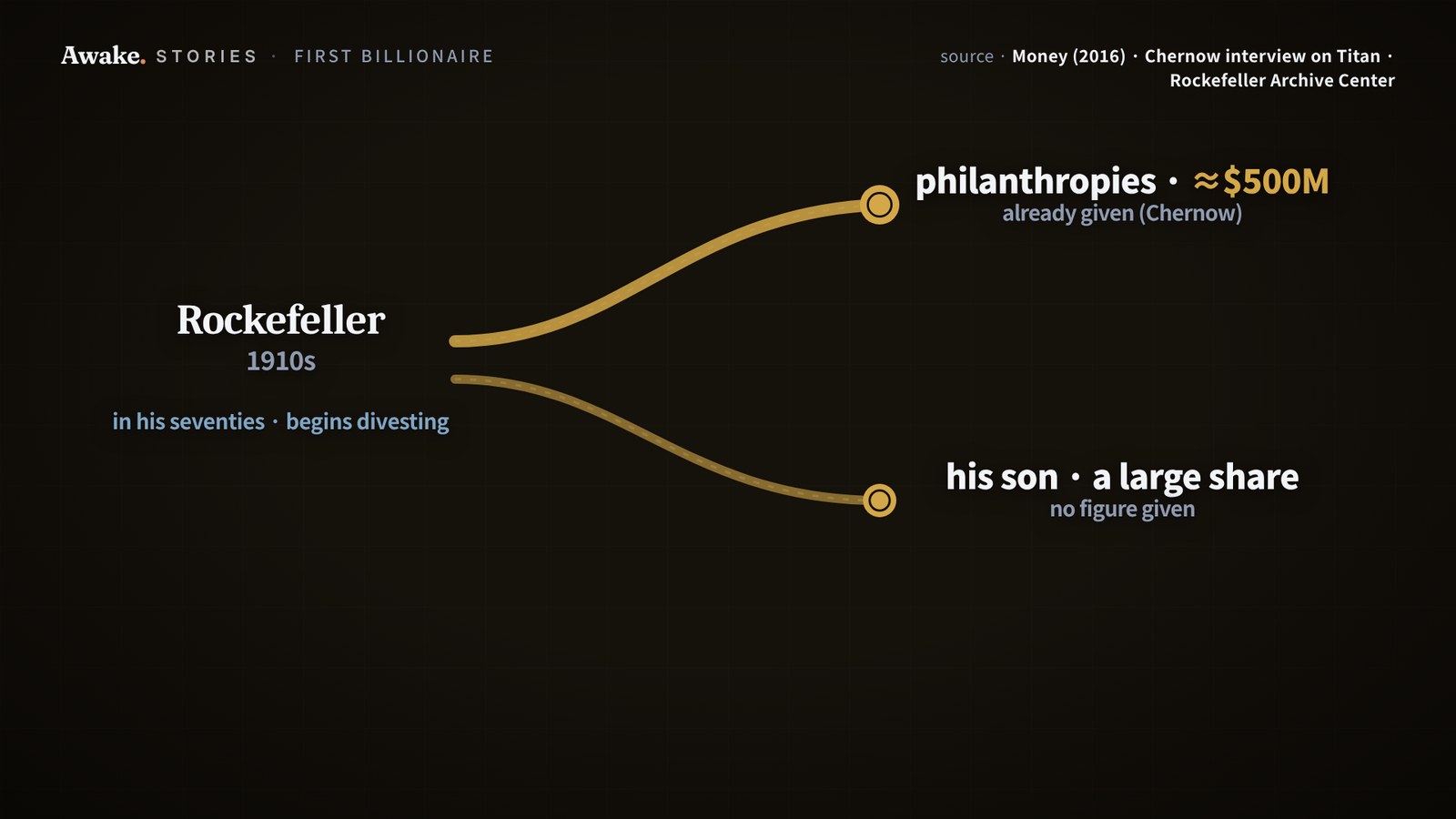
Over the 1910s, in his seventies, Rockefeller began divesting. Biographer Ron Chernow, author of Titan, said in an interview that about $500 million had gone to his philanthropies and that a large share went to his son. Counting only the charity, the Rockefeller Archive Center puts his lifetime charitable gifts at $540 million.
That leaves an obvious question. If so much was leaving in the 1910s, how big did the fortune get at its very top?
The peak that stopped short of a billion
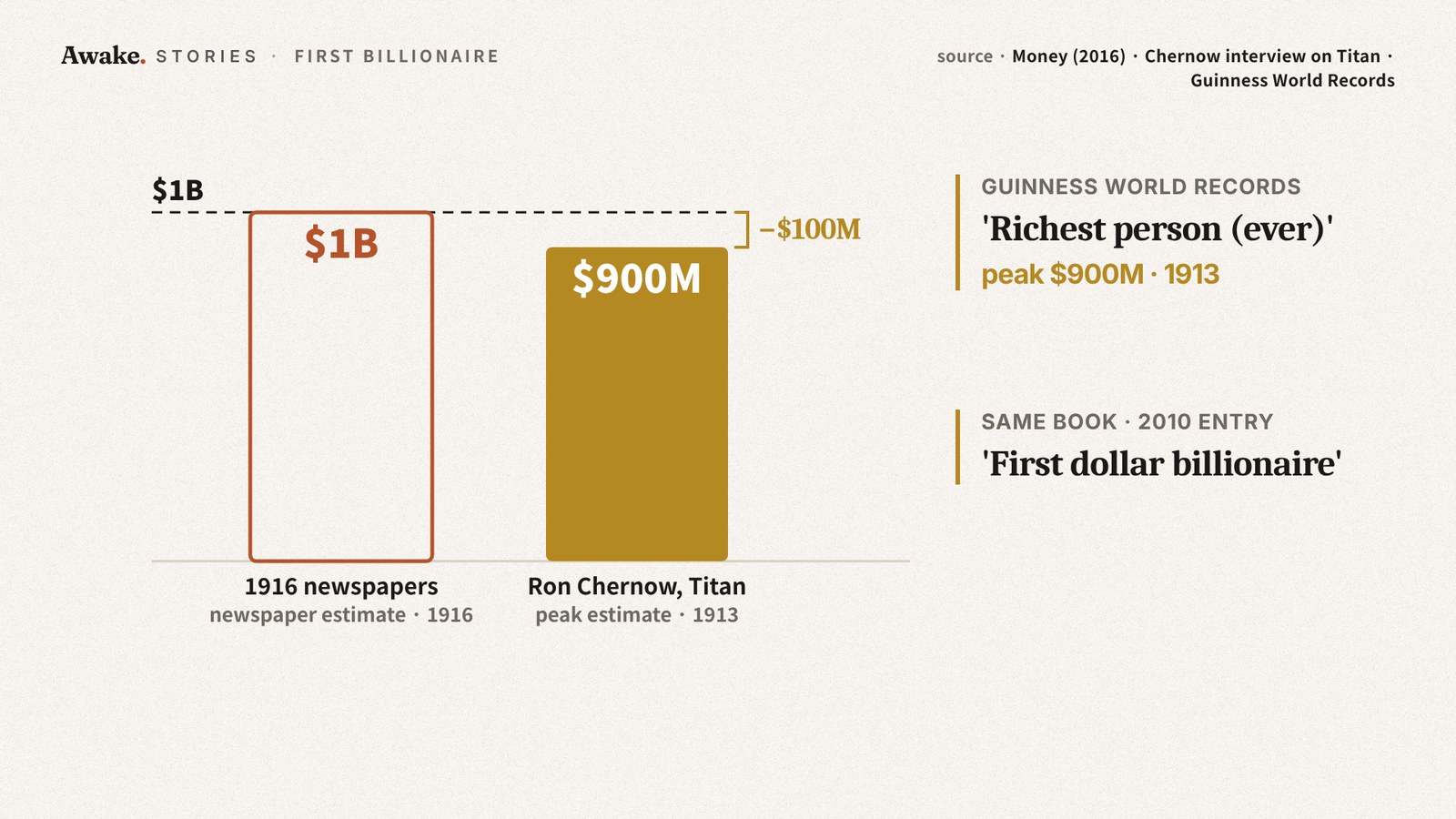
Chernow’s answer is $900 million, in 1913. On his estimate, the fortune peaked three years before the headlines and was still $100 million short of their billion. Now for the second Guinness page. Its “Richest person (ever)” entry gives the same peak, $900 million in 1913. The record book that once called him the first dollar billionaire also puts his best year below the line.
The decline afterwards is steeper still. After the giving, Chernow says, Rockefeller kept only about $25 million for himself to play the stock market. The 1929 crash then cut his personal fortune to about $7 million. That was a low point rather than the end. Chernow describes him fighting to rebuild it and still trading days before he died, but he gives no final figure.
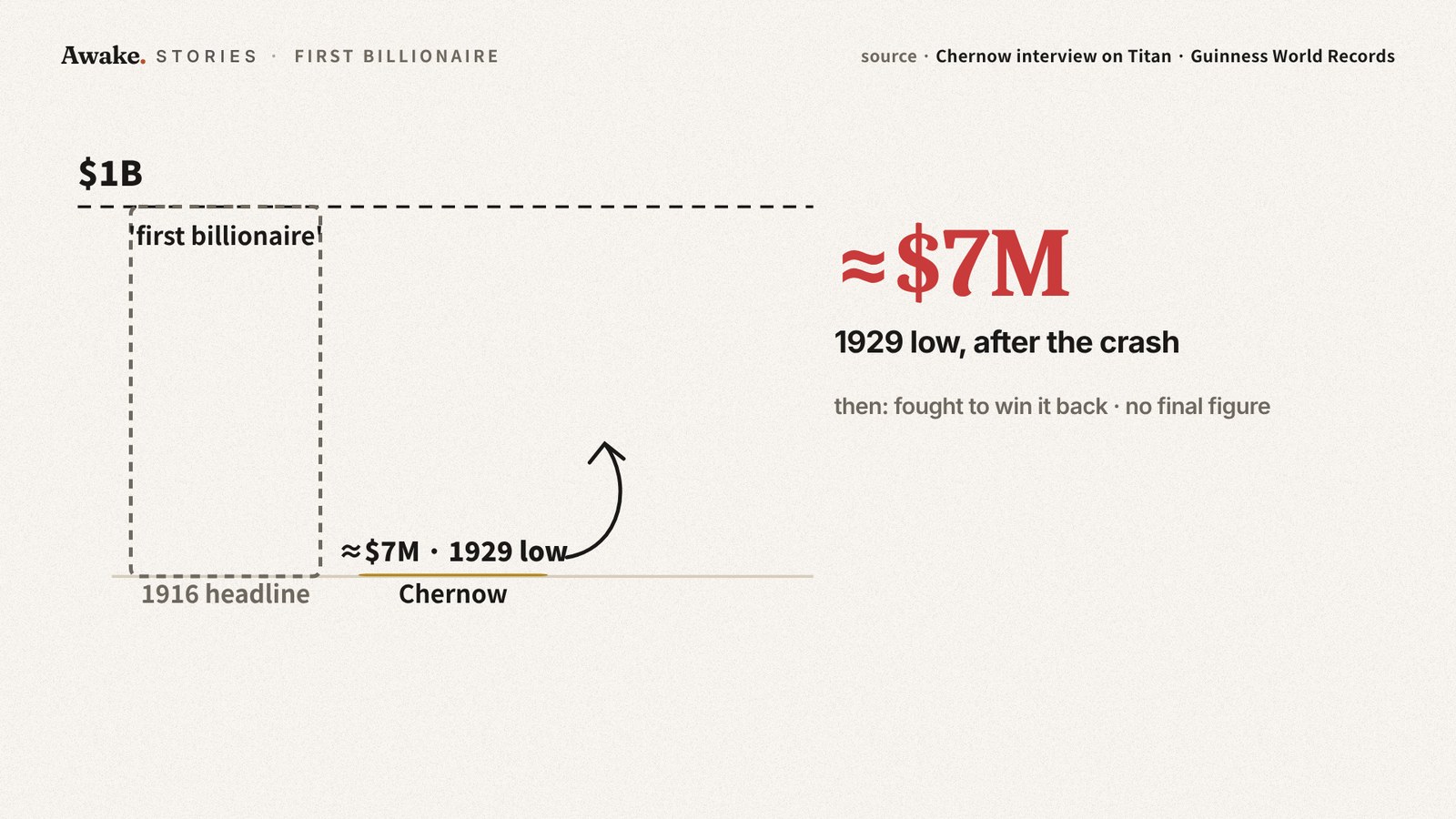
Not every record agrees. Guinness’s 2010 “First dollar billionaire” entry credited him with an estimated $1.4 billion at his death in 1937. The two Guinness pages contradict each other, and Chernow’s figures match the second one. The video walks through these numbers on a single axis, which makes the drop easy to see. On these estimates, the most famous billionaire may never have reached a billion at all.
Henry Ford and the question of who was first
So who did? In the argument over America’s first billionaire, many historians point to Henry Ford. In 1919, according to The Henry Ford archive, he bought out all of Ford Motor’s outside stockholders, and from then on only his family held shares. By about 1925, Money’s 2016 account says, Ford seems to have reached ten figures. Money itself calls that an approximate estimate.
Even this argument covers only the United States. None of these sources settles who crossed the line first anywhere in the world. The question in the title therefore has two parts. The American part is disputed, with an estimate on each side. The worldwide part is still open.
What changes once you see it
In the end, “first billionaire” is a story about counting. Rockefeller’s crown came from a newspaper estimate, and Ford’s rests on an approximate one. Even “richest ever” rankings depend on method. Guinness converts the 1913 peak of $900 million into 2024 dollars three ways: $28 billion by prices, $163 billion by wages, and $631 billion by share of the economy.
The famous billion tells you the least of all, because by Chernow’s account most of the fortune went to philanthropies and to his son. When Rockefeller died in 1937, his New York Times obituary did call him a “billionaire”, in quotation marks, according to Money’s 2016 account.
Sources
- America's First Billionaire Isn't the Guy We Thought (Greg Daugherty) — Money (money.com) (2016) · https://money.com/4480022/first-american-billionaire-dispute/
- Paul Schindler interview with Ron Chernow on Titan: The Life of John D. Rockefeller, Sr. — schindler.org (author interview transcript) (1913) · https://schindler.org/profile/rchernow/interview.html
- First dollar billionaire (Wayback Machine snapshot, 2022-12-30) — Guinness World Records (2010) · https://web.archive.org/web/20221230155538/https://www.guinnessworldrecords.com/world-records/first-dollar-billionaire
- Richest person (ever) - adjusted for inflation — Guinness World Records (1913) · https://www.guinnessworldrecords.com/world-records/74539-richest-person-ever-adjusted-for-inflation
- John D. Rockefeller, 1839-1937 (biography) — Rockefeller Archive Center (1911) · https://rockarch.org/resources/about-the-rockefellers/john-d-rockefeller-sr/
- John D. Rockefeller, Sr., makes additional gifts to RF (history timeline) — The Rockefeller Foundation (1937) · https://rockefellerfoundation.org/history/john-d-rockefeller-sr-makes-additional-gifts-to-rf-bringing-the-total-of-all-gifts-he-made-to-rf-to-182851480-90-equal-to-2-8-billion-in-current-dollars
- The First Billion-Dollar Company — Finaeon (Global Financial Data) (1912) · https://finaeon.com/the-first-billion-dollar-company/
- Research Guide: Ford Motor Company Stockholders and Stock, 1903-1956 — The Henry Ford (Benson Ford Research Center) (1919) · https://askus.thehenryford.org/researchguides/faq/414680
- Rockefeller: Making of a Billionaire (Inside Adams blog) — Library of Congress (2020) · https://blogs.loc.gov/inside_adams/2020/01/rockefeller-billionaire/
- Consumer Price Index for All Urban Consumers: All Items in U.S. City Average (CPIAUCNS), annual average, 1982-84=100 — U.S. Bureau of Labor Statistics via FRED, Federal Reserve Bank of St. Louis (1913) · https://fred.stlouisfed.org/graph/fredgraph.csv?id=CPIAUCNS&fq=Annual&fam=avg&cosd=1913-01-01
Photos: Image: ha11ok / Pixabay (https://pixabay.com/photos/typewriter-vintage-old-1248088/) · Video: Miguel Á. Padriñán / Pexels (https://www.pexels.com/video/typing-words-in-an-old-typewriter-2752278/) · Photo: Donatello Trisolino / Pexels (https://www.pexels.com/photo/close-up-photo-of-calligraphy-print-on-paper-2355408/) · Photo: Mark Stebnicki / Pexels (https://www.pexels.com/photo/industrial-refinery-by-the-river-at-sunset-39004121/) · Photo: Ylanite Koppens / Pexels (https://www.pexels.com/photo/a-close-up-shot-of-newspapers-13081133/) · Image: jarekgrafik / Pixabay (https://pixabay.com/photos/sanok-open-air-museum-1003241/) · Image: Felix-Mittermeier / Pixabay (https://pixabay.com/photos/newspaper-old-1925-daily-newspaper-2608394/)
 Up next · TechWhy Keyboards Are QWERTY: The Jam Myth vs. the Telegraph Record